
APPLICATION

- Home
- Application
- Esports Display
- Vismotion-M|MPRT & Display Motion Blur Measurement System
Vismotion-M | MPRT & Display Motion Blur Measurement System
The pursuit-camera system used to produce the MPRT data published by NVIDIA for G-SYNC Pulsar and OLED displays.Named by NVIDIA. NVIDIA's official forum article “MPRT, Pulsar and OLED” and its G-SYNC Pulsar firmware release notes
both state that the published MPRT figures were measured with the iboson Vismotion system.
Three Reasons Modern Display Technology Needs MPRT
- Beyond GtG Limitations - Traditional Grey-to-Grey (GtG) response time does not capture the persistence blur
produced by the sample-and-hold mechanism during smooth pursuit eye movement. On OLED and other
fast-switching panels, GtG approaches zero but blur is still present because of the hold nature of the display.
Using MPRT differentiates these products based on true perceivable motion blur. - Evaluating Motion Blur Reduction Techniques - MPRT is essential to quantify the actual performance of backlight
strobing and frame insertion technologies such as ULMB, DyAc, ELMB, MBR, Pulsar and BFI. These techniques
shorten emission time rather than pixel transition time, so GtG does not change even when perceived blur falls substantially. - Optimisation for Esports and VR/AR - MPRT provides an objective motion clarity metric for Overdrive tuning, for
dynamic target tracking in competitive gaming, and for reducing motion sickness in VR and AR applications.
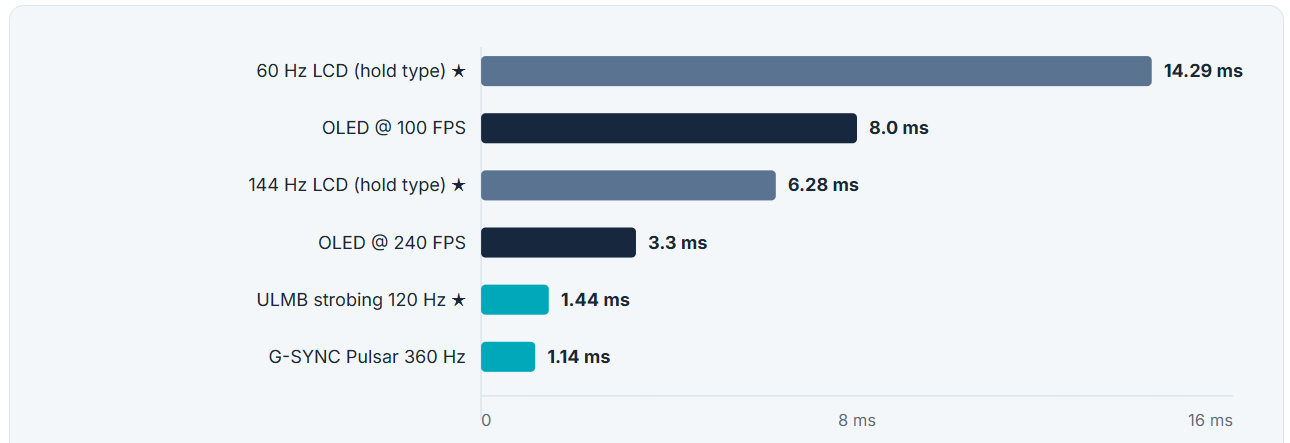
Figure 1 — MPRT turns a technology difference into a single number. The OLED with the fastest GtG still trails a strobed-backlight LCD in MPRT. ★ measured by iboson. The 1.14 ms figure for G-SYNC Pulsar at 360 Hz (≈ 877 Hz equivalent) is the Vismotion-M average published by NVIDIA on its official forum; OLED values are derived from the same article using MPRT ≈ 0.8 × frame time.
Features
- MPRT Measurement - Simulates smooth pursuit eye movement to quantify perceived motion blur, reported as Blurred Edge Time (BET) across a full grey-level matrix.
- Pursuit Tracking Emulation - A physically tracking camera replicates smooth pursuit eye movement, so the blur forms optically on the sensor rather than being reconstructed in software.
- Direct GPU Output - Smoothly scrolled test patterns are rendered directly through the graphics card under software control, nsuring precise timing between the pattern and the tracking axis.
- Exclusive Alignment Calibration - Proprietary alignment correction technology with on-screen crosshair guidance ensures accurate and repeatable results.
- Simultaneous Data Logging - Captured images and measurement curves are recorded together and can be reviewed at any time, with results exported as CSV for further analysis.
- Three Cross-Checking Views - 3D distribution, transition curve and camera capture can be cross-referenced to confirm that every grey-level pair measured correctly.
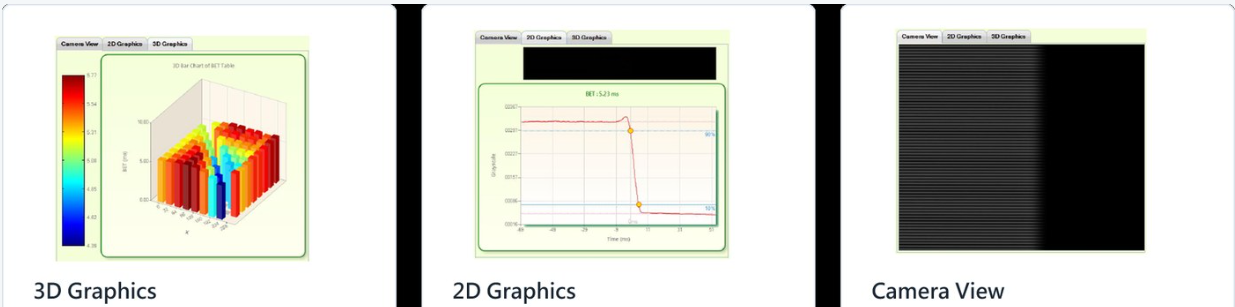
Figure 2 — Three views in the measurement software. Left to right: 3D Graphics reveals the worst grey-level pairs at a glance; 2D Graphics shows the transition curve for the selected pair, used to judge whether the waveform is sound; Camera View displays the actual capture for that pair. Stepping through the matrix to cross-check all three is the key step in validating a measurement run.
Description
- iboson Vismotion-M is a visual motion analysis system engineered to evaluate response time, motion blur and optical performance in displays. Combining a pursuit camera with high-precision analytical algorithms, it captures the blur exactly as the human eye receives it, delivering actionable data for product R&D and manufacturing optimisation.
- Vismotion-M is designed for monitors and gaming displays measured as complete units, including high refresh rate esports panels and televisions. Measurements published by NVIDIA for 27-inch G-SYNC Pulsar and OLED monitors were produced with this system. For small and medium panels and modules, the Vismotion-R variant covers 2 to 10 inch samples.
- Typical applications include esports monitor development, panel driving and Overdrive optimisation, backlight strobing evaluation, and motion clarity assessment for VR and AR displays.

Figure 3 — The numbers match the eye. Left to right: OLED at 100 FPS (MPRT 7.62 ms), Pulsar at 100 FPS (MPRT 2.05 ms), OLED at 150 FPS (MPRT 5.08 ms), Pulsar at 150 FPS (MPRT 1.48 ms), captured with a colour pursuit camera. In the same content Pulsar keeps the “Readability Test” text legible while OLED smears — the MPRT difference is visible to the naked eye. Captures as published by NVIDIA.
Why test conditions must always be stated
The same monitor yields very different figures depending on refresh rate, pulse width and firmware version. NVIDIA's firmware 1.1.10 release notes report the following measured improvements, taken with Vismotion-M.
| Condition | Before | Firmware 1.1.10 |
| 240 Hz, pulse width 50 | — | 0.97 ms — below 1.0 ms, > 1000 Hz equivalent |
| 360 Hz at 480 nits | 1.64 ms | 1.14 ms |
| 240 Hz at 480 nits | 2.05 ms | 1.37 ms — up to 33 % improvement |
Values as published by NVIDIA for Pulsar monitor firmware 1.1.10 (the current release at time of writing), measured with Vismotion-M. Figures move with each firmware release — measurement data should always be dated and versioned.
| Specifications | |
|---|---|
| Item | Vismotion-M |
| Supported product | 27" FHD, up to 1000 Hz |
| Metric | MPRT (Blurred Edge Time) |
| Horizontal pixels | 2448 px
|
| Resolvable blur width | 10.6 µm |
| Field of view | 26 mm (interchangeable lens) |
| Max tracking speed | 300 mm/s |
| MPRT average error | within ±2% |
| Measurement height range | 120 – 550 mm |
| Dimensions / weight | 820 × 650 × 870 mm / 15 kg |
| Outputs | MPRT with max / min BET, grey-level transition curves, 3D distribution view, captured images, CSV logs |
Why Choose iboson's MPRT Solution
- Named in NVIDIA's published data - NVIDIA's official forum article and its G-SYNC Pulsar firmware release notes both state that the published MPRT figures were measured with iboson Vismotion-M — the method behind your data is already on the public record.
- Optical integration, not software reconstruction - The camera physically tracks the moving pattern, so blur forms directly on the sensor during a multi-frame exposure. Signal remains strong even at low luminance, with no lengthy post-processing.
- Comparable with your customers' data - In use at NVIDIA and at major panel and monitor manufacturers, and specified as the reference method by several global PC brands — reducing methodology disputes at acceptance.
- Validated through published research - The measurement method has been presented in joint research at SID, giving it international technical credibility.
What's Next: Vismotion-M2 (coming soon)
To address next-generation display architectures — including refresh rates beyond 1000 Hz and the VESA ClearMR certification standard — iBoson will introduce Vismotion-M2, extending measurement to 27-inch FHD at up to 3000 Hz and adding CMR output alongside MPRT.
- CMR / VESA ClearMR - Both MPRT and CMR from one system, directly addressing ClearMR certification needs.
- 27" FHD at 3000 Hz - Refresh rate support tripled, covering NVIDIA 1000 Hz+, BOE 1500 Hz and 2000 Hz evaluations.
- Color Capture - Real colour UFO captures give customers visible evidence alongside the numbers.
- Adjustable grey steps - Custom grey-level intervals for ClearMR's non-uniform levels and customer-defined conditions.
- Selective re-measurement - Re-run a single suspect grey pair instead of the whole matrix, saving significant time.
- +40 % Higher waveform resolution - Finer sampling of the transition curve stabilises knee-point and blur-edge detection — the basis of every CMR figure.